Showing posts with label philosophy. Show all posts

Saturday, April 19, 2014

"What do you do?"

A simple question that reveals how passionate someone is about their occupation. You meet someone at a gathering and ask them their name, and they enthusiastically (and almost immediately) reply. You ask them where they live, and you get a similar enthusiastic quick reply. Then, you ask them what they do, and you will see two kinds of people:

The first kind is the group of satisfied and successful professionals who exude the confidence and are enthusiastic about their profession. They reply with the same enthusiasm and quickness.

The second kind is the group of people who are not really excited about their occupation, and are just going along to make a living. These people will drone about what they do without any excitement or enthusiasm. These are the ones that need to look inside themselves, find what they are passionate about, and go after it.

Find an occupation that makes you proud. Find an occupation that makes you get up everyday looking forward to going to work.

I remember reading a resume writing book where the author said that we should fine tune our resumes until it is fit to be framed and hung on the wall. Same here. You need to find a profession that you are proud of proclaiming it and announcing it to the world.

Find your passion today and go after it.

Wednesday, November 09, 2011

Lessons from the Last Lecture

Randy Pausch gave this moving last lecture. It is a must watch.


Some lessons I captured from this lecture:
  • Experience is what you get when you don’t get what you wanted.
  • We cannot change the cards we are dealt with. Just how we play the hand.
  • Have something to bring to the table. That will make you more welcome.
  • You've got to get the fundamentals down. Otherwise, the fancy stuff won't work.
  • When you see yourself doing something badly, and no one is bothering to correct you anymore, that's a very bad place to be. That means, people have given up on you.
  • Brick walls: They are there for a reason. They are not there to keep you out. They are there to see how badly you want something.
  • Wait long enough and people will surprise/impress you. Give people time to show their good side.
  • It is very important to know that you are in a pissing match. And, it is very important to get out of it as soon as possible.
  • Never ever underestimate the importance of having fun.
  • Work and play well with people.
  • If you live your life the right way, your dreams will come true.
  • If you are going to do anything pioneering you will get arrows in the back, and you just have to put up with it.
  • You just have to decide if you are going to be a Tigger or an Eeyore.
  • Loyalty is a two way street.
  • You can't get there alone. People have to help you. I do believe in karma and paybacks. You get people to hepl you by telling the truth.
  • I'll take an earnest person over a hip person every day, because hip is short term and earnest is long term.
  • Apologize when you screw up and focus on other people.
  • Say you are sorry that you screwed up.
  • Say that it is your fault.
  • Ask how you can correct it.
  • Don’t complain. Just work harder.
  • Be good at something. That makes you valuable.
  • Be prepared. Luck is truly where preparation meets opportunity.

Monday, November 07, 2011

ROL

Here is an interesting HBR blog on managing luck. The premise of this blog entry is that everyone has 'good' as well as 'bad' luck almost equally. But, what sets winners apart from also-rans is the Return on Luck. What you do with an opportunity (good luck) that is presented to you defines how lucky you are.

Morten lays out 4 simple steps to managing luck:
1. View life as a flow of luck events
2. Prepare for bad-luck events
3. Spot good-luck events when they come
4. Execute brilliantly on good-luck events

These steps will allow you to maximize your ROL.

Tuesday, August 03, 2010

Being Better is Better

This is a must see video of Kathy Sierra talking at the Business of Software 2009 conference.
She talks not about making a killer app, but about making a killer user (of your app).
She stresses the importance of creating an amazing user experience, and making an amazing user of your product/service.
Great talk.

Wednesday, September 19, 2007

Green Ganapathi

Every year we celebrate Ganesha Chaturthi and I make it a point to make my own Ganesha idol. The main reason being that I love creating it. I believe that it is a service to God when I put my skills and effort to craft the idol. It gives me great pleasure to create the idol and worship it on Ganesha Chaturthi.

I mostly use clay to model the idol, and since I don't bake the model, I paint it with a water based paint. My philosophy has always been to use the materials available in nature, and around us. I say that I mostly use clay because I use other materials (paper, cardboard, wire) to provide the skeleton to the model and hold it together. This is especially true for the four hands as well as the trunk.

The Hindu scriptures say that Goddess Parvathi created Ganesha out of the dirt (saffron paste) off her body. In order to follow a similar route, some say that we should only create the idol out of clay (earth, sand, dirt, etc.). I have always used clay to create my idols. I love the texture and pliable nature of clay. I love working with clay.

And, at the time of immersion, it is fitting that we give back to nature, what came from nature. Clay lets me accomplish this.

Nowadays, people have started using all kinds of materials to create the Ganesha idol. The most common one being plaster-of-paris. First, plaster-of-paris is not a naturally occurring material. Second, plaster-of-paris does not disintegrate easily when immersed in water. Plaster-of-paris is not a nature friendly material. To top it, most manufacturers use oil or latex based paints to obtain a glossy look. Even these are not environment friendly, and are known to harm fish and other marine life.

Since the practice is always to immerse the idol back into water after the pooja, why not make the idol out of the materials we find in riverbeds or lakes: Clay.

Always buy or create idols made of clay, and water based natural paints. Let lord Ganesha help keep this planet green.

OM Sri Ganeshaya Namaha.

Monday, July 09, 2007

Child labor?


Last week, while strolling on a street in Waikiki, I saw several street performers entertaining passers by. Here is a rough estimate of number of onlookers flocking around the performers, at the time I was there:

Caricature artist - 0
Basketball man (guy performing basketball tricks) - 25
Charcoal portrait artist - 8
Golden statue dude (guy posing as a golden statue) - 10
Ukulele player - 0
Karaoke girl (girl singing pop songs on a karaoke machine) - 18
Guitar player - 0
At first glance, everything seems in balance. Not a lot of general public cares for a guy playing the ukulele or shredding the guitar on the streets. These need very specific audience. Same goes true for the caricature artist.
The charcoal dude was doing an awesome job, and hence people were flocking to watch him work (many were waiting their turn). The basketball man was attracting a huge crowd by yapping a lot (and doing a few real cool tricks).
What struck me was the fact that people were watching a young girl (maybe 8-10 yrs old) singing while her parents were sitting around and collecting money (pic above). This, for me, is child labor. We talk a lot about what happens in China and other countries, and here we were, encouraging a little girl (and her parents) to sing for us. The girl should have been playing with her friends in the beach on that pleasant evening. Instead, she was 'working' for her parents. What a pity.

BTW, I just took a few pics and walked away as soon as possible. I, for one, did not want to encourage this.

Sunday, May 06, 2007

What is your passion?

Did you know that people age faster in their retired life?
Did you know that people develop all kinds of (imaginary or not) ailments as soon as they retire?

Research has shown that the main reason for all this is the lack of purpose in life. Once a person retires and stops working, he looses a reason to get up in the morning, and go get something done. The other reason is boredom and depression. That is one of the reasons retirees look for part-time work in their retirement.

Without passion for something in life, it is hard to make a retired living.

What is retirement?

Earlier, people considered retirement once they reached a particular age. Retirement is considered once you have financial freedom. What we need to realize is that retirement can be boring and frustrating, if it is not properly thought out.

What would you do if you had financial freedom?

If you answer that question with something that you are not doing now, you are up for a boring retired life.

Who are you?

When you are asked who you are, you reply that you are a doctor or a professor or ... So, your profession defines you, especially for professional people. In a society where your profession defines you, it is hard to be retired. It is hard to lose one's identity.

When anyone asks one of my friends what he does, his answer is "I am a musician". "And, I just do database administration at ABC Corp just to pay my bills". That is an interesting way of putting things. Of course, it would have been a lot better if his passion could pay the bills too.

Without a passion, it is hard to pass time. If you are passionate about something, what keeps you from doing it now? Why are you waiting to be "retired" to do something that you love?

Pick your passion today, and start practicing retirement!

Thursday, February 22, 2007

Learning from the West

During my recent visit to Bangalore, I noticed a strange behavior. I saw trash and filth all over sidewalks, roads, and public places. People weren't thinking twice before discarding an empty coke can or spitting a piece of gum onto the sidewalk. It was not their problem, but the city's, to keep the roads and sidewalks clean. And, 'everyone is doing it, so why shouldn't I' was the attitude.

The same person enters one of the Westernized malls and suddenly his behavior changes. All the malls in Bangalore are squeaky clean (even though they are over crowded). You cannot find a piece of trash anywhere but inside the trash cans. I wondered what caused this sudden change in behavior. The most unfortunate part was that the behavior change was only temporary, and vanished as soon as the person left the mall premises.

Was it the cleanliness to start off with? Not really. Any new public place will start out clean and slowly degrade. But, the malls were different. Even two year old malls were shiny and clean.

Was it the cleaning staff at these malls? No. I did not notice anyone following people around and cleaning after them.

I could not put my finger on this strange behavior ....

Among the many things that I noticed when I first set foot in this country was the fact that people understand their civic duties and their rights. They understand how the cities function. I remember naively telling my professor that we had public hospitals in India that are free to everyone. He immediately said that it is not free. It is paid for by the tax payers. If only people realize this fact, they would demand better care from the public hospitals instead of flocking into private facilities and paying big bucks.

In another instance, I noticed the school staff wearing black ribbons as a form of protest. Again here, I drew a contrast on how we protest in India. Bundhs, strikes and riots accompanied by stoning public (and private) buildings and destroying property. People were shocked to hear that. "Don't they understand that public property is YOUR property? You are finally going to pay for fixing or replacing what you destroyed."

That is awareness, and pride. Pride in what you have achieved as a collective whole. Awareness of where your taxes go and how they are used.

These are a few incidents that were eye openers for me. I always wondered what is missing in India. And what could make people more aware of their responsibilities, and make India a better place.

I recently happened to read this speech by Narayana Murthy (Infosys) on this very same subject that hit at the heart of many issues facing India. It is a very thought provoking read. I have included it here for your reading pleasure.

----------------

I decided to speak on an important topic on which I have pondered for years - the role of Western values in contemporary Indian society. Coming from a company that is built on strong values, the topic is close to my heart. Moreover, an organization is representative of society, and some of the lessons that I have learnt are applicable in the national context. In fact, values drive progress and define quality of life in society.

The word community joins two Latin words com (”together” or “with”) and unus (”one”). A community, then, is both one and many. It is a unified multitude and not a mere group of people. As it is said in the Vedas: Man can live individually, but can survive only collectively. Hence, the challenge is to form a progressive community by balancing the interests of the individual and that of the society. To meet this, we need to develop a value system where people accept modest sacrifices for the common good.

What is a value system? It is the protocol for behavior that enhances the trust, confidence and commitment of members of the community. It goes beyond the domain of legality - it is about decent and desirable behavior. Further, it includes putting the community interests ahead of your own. Thus, our collective survival and progress is predicated on sound values.

There are two pillars of the cultural value system - loyalty to family and loyalty to community. One should not be in isolation to the other, because, successful societies are those which combine both harmoniously. It is in this context that I will discuss the role of Western values in contemporary Indian society.

Some of you here might say that most of what I am going to discuss are actually Indian values in old ages, and not Western values. I live in the present, not in the bygone era. Therefore, I have seen these values practiced primarily in the West and not in India. Hence, the title of the topic.
I am happy as long as we practice these values - whether we call it Western or old Indian values. As an Indian, I am proud to be part of a culture, which has deep-rooted family values. We have tremendous loyalty to the family. For instance, parents make enormous sacrifices for their children. They support them until they can stand on their own feet. On the other side, children consider it their duty to take care of aged parents.

We believe: Mathru devo bhava - mother is God, and pithru devo bhava - father is God. Further, brothers and sisters sacrifice for each other. In fact, the eldest brother or sister is respected by all the other siblings. As for marriage, it is held to be a sacred union - husband and wife are bonded, most often, for life. In joint families, the entire family works towards the welfare of the family. There is so much love and affection in our family life.

This is the essence of Indian values and one of our key strengths. Our families act as a critical support mechanism for us. In fact, the credit to the success of Infosys goes, as much to the founders as to their families, for supporting them through the tough times. Unfortunately, our attitude towards family life is not reflected in our attitude towards community behavior. From littering the streets to corruption to breaking of contractual obligations, we are apathetic to the common good. In the West - the US, Canada, Europe, Australia, New Zealand - individuals understand that they have to be responsible towards their community.

The primary difference between the West and us is that, there, people have a much better societal orientation. They care more for the society than we do. Further, they generally sacrifice more for the society than us. Quality of life is enhanced because of this. This is where we need to learn from the West.

I will talk about some of the lessons that we, Indians, can learn from the West.

In the West, there is respect for the public good. For instance, parks free of litter, clean streets, public toilets free of graffiti - all these are instances of care for the public good. On the contrary, in India, we keep our houses clean and water our gardens everyday - but, when we go to a park, we do not think twice before littering the place.

Corruption, as we see in India, is another example of putting the interest of oneself, and at best that of one’s family, above that of the society. Society is relatively corruption free in the West. For instance, it is very difficult to bribe a police officer into avoiding a speeding ticket.

This is because of the individual’s responsible behavior towards the community as a whole On the contrary, in India, corruption, tax evasion, cheating and bribery have eaten into our vitals. For instance, contractors bribe officials, and construct low-quality roads and bridges. The result is that society loses in the form of substandard defence equipment and infrastructure, and low-quality recruitment, just to name a few impediments. Unfortunately, this behavior is condoned by almost everyone.

Apathy in solving community matters has held us back from making progress, which is otherwise within our reach. We see serious problems around us but do not try to solve them. We behave as if the problems do not exist or is somebody else’s. On the other hand, in the West, people solve societal problems proactively. There are several examples of our apathetic attitude. For instance, all of us are aware of the problem of drought in India.

More than 40 years ago, Dr. K. L. Rao - an irrigation expert, suggested creation of a water grid connecting all the rivers in North and South India, to solve this problem. Unfortunately, nothing has been done about this. The story of power shortage in Bangalore is another instance. In 1983, it was decided to build a thermal power plant to meet Bangalore’s power requirements. Unfortunately, we have still not started it. Further, the Milan subway in Bombay is in a deplorable state for the last 40 years, and no action has been taken.

To quote another example, considering the constant travel required in the software industry; five years ago, I had suggested a 240-page passport. This would eliminate frequent visits to the passport office. In fact, we are ready to pay for it. However, I am yet to hear from the Ministry of External Affairs on this.

We, Indians, would do well to remember Thomas Hunter’s words: Idleness travels very slowly, and poverty soon overtakes it. What could be the reason for all this? We were ruled by foreigners for over thousand years. Thus, we have always believed that public issues belonged to some foreign ruler and that we have no role in solving them.

Moreover, we have lost the will to proactively solve our own problems. Thus, we have got used to just executing someone else’s orders. Borrowing Aristotle’s words: We are what we repeatedly do. Thus, having done this over the years, the decision-makers in our society are not trained for solving problems. Our decision-makers look to somebody else to take decisions. Unfortunately, there is nobody to look up to, and this is the tragedy.

Our intellectual arrogance has also not helped our society. I have traveled extensively, and in my experience, have not come across another society where people are as contemptuous of better societies as we are, with as little progress as we have achieved. Remember that arrogance breeds hypocrisy. No other society gloats so much about the past as we do, with as little current accomplishment.

Friends, this is not a new phenomenon, but at least a thousand years old. For instance, Al Barouni, the famous Arabic logician and traveler of the 10th century, who spent about 30 years in India from 997 AD to around 1027 AD, referred to this trait of Indians. According to him, during his visit, most Indian pundits considered it below their dignity even to hold arguments with him. In fact, on a few occasions when a pundit was willing to listen to hm, and found his arguments to be very sound, he invariably asked Barouni: which Indian pundit taught these smart things!

The most important attribute of a progressive society is respect for others who have accomplished more than they themselves have, and learn from them. Contrary to this, our leaders make us believe that other societies do not know anything! At the same time, everyday, in the newspapers, you will find numerous claims from our leaders that ours is the greatest nation. These people would do well to remember Thomas Carlyle’s words: The greatest of faults is to be conscious of none.

If we have to progress, we have to change this attitude, listen to people who have performed better than us, learn from them and perform better than them. Infosys is a good example of such an attitude. We continue to rationalize our failures. No other society has mastered this part as well as we have. Obviously, this is an excuse to justify our incompetence, corruption, and apathy. This attitude has to change. As Sir Josiah Stamp has said: It is easy to dodge our responsibilities, but we cannot dodge the consequences of dodging our responsibilities.

Another interesting attribute, which we Indians can learn from the West, is their accountability. Irrespective of your position, in the West, you are held accountable for what you do. However, in India, the more ‘important’ you are, the less answerable you are. For instance, a senior politician once declared that he ‘forgot’ to file his tax returns for 10 consecutive years - and he got away with it. To quote another instance, there are over 100 loss making public sector units (central) in India. Nevertheless, I have not seen action taken for bad performance against top managers in these organizations.

Dignity of labor is an integral part of the Western value system. In the West, each person is proud about his or her labor that raises honest sweat. On the other hand, in India, we tend to overlook the significance of those who are not in professional jobs. We have a mind set that reveres only supposedly intellectual work.

For instance, I have seen many engineers, fresh from college, who only want to do cutting-edge work and not work that is of relevance to business and the country. However, be it an organization or society, there are different people performing different roles. For success, all these people are required to discharge their duties. This includes everyone from the CEO to the person who serves tea - every role is important. Hence, we need a mind set that reveres everyone who puts in honest work.

Indians become intimate even without being friendly. They ask favors of strangers without any hesitation. For instance, the other day, while I was traveling from Bangalore to Mantralaya, I met a fellow traveler on the train. Hardly 5 minutes into the conversation, he requested me to speak to his MD about removing him from the bottom 10% list in his company, earmarked for disciplinary action. I was reminded of what Rudyard Kipling once said: A westerner can be friendly without being intimate while an easterner tends to be intimate without being friendly.
Yet another lesson to be learnt from the West, is about their professionalism in dealings. The common good being more important than personal equations, people do not let personal relations interfere with their professional dealings. For instance, they don’t hesitate to chastise a colleague, even if he is a personal friend, for incompetent work.

In India, I have seen that we tend to view even work interactions from a personal perspective. Further, we are the most ‘thin-skinned’ society in the world - we see insults where none is meant. This may be because we were not free for most of the last thousand years. Further, we seem to extend this lack of professionalism to our sense of punctuality. We do not seem to respect the other person’s time.

The Indian Standard Time somehow seems to be always running late. Moreover, deadlines are typically not met. How many public projects are completed on time? The disheartening aspect is that we have accepted this as the norm rather than the exception. In the West, they show professionalism by embracing meritocracy. Meritocracy by definition means that we cannot let personal prejudices affect our evaluation of an individual’s performance. As we increasingly start to benchmark ourselves with global standards, we have to embrace meritocracy.

In the West, right from a very young age, parents teach their children to be independent in thinking. Thus, they grow up to be strong, confident individuals. In India, we still suffer from feudal thinking. I have seen people, who are otherwise bright, refusing to show independence and preferring to be told what to do by their boss. We need to overcome this attitude if we have to succeed globally.

The Western value system teaches respect to contractual obligation. In the West, contractual obligations are seldom dishonored. This is important - enforceability of legal rights and contracts is the most important factor in the enhancement of credibility of our people and nation.
In India, we consider our marriage vows as sacred. We are willing to sacrifice in order to respect our marriage vows. However, we do not extend this to the public domain. For instance, India had an unfavorable contract with Enron. Instead of punishing the people responsible for negotiating this, we reneged on the contract - this was much before we came to know about the illegal activities at Enron.

To quote another instance, I had given recommendations to several students for the national scholarship for higher studies in US universities. Most of them did not return to India even though contractually they were obliged to spend five years after their degree in India.
In fact, according to a professor at a reputed US university, the maximum default rate for student loans is among Indians - all of these students pass out in flying colors and land lucrative jobs, yet they refuse to pay back their loans. Thus, their action has made it difficult for the students after them, from India, to obtain loans. We have to change this attitude.

Further, we Indians do not display intellectual honesty. For example, our political leaders use mobile phones to tell journalists on the other side that they do not believe in technology! If we want our youngsters to progress, such hypocrisy must be stopped. We are all aware of our rights as citizens. Nevertheless, we often fail to acknowledge the duty that accompanies every right. To borrow Dwight Eisenhower’s words: People that values its privileges above its principles soon loses both. Our duty is towards the community as a whole, as much as it is towards our families.
We have to remember that fundamental social problems grow out of a lack of commitment to the common good. To quote Henry Beecher: Culture is that which helps us to work for the betterment of all. Hence, friends, I do believe that we can make our society even better by assimilating these Western values into our own culture - we will be stronger for it.

Most of our behavior comes from greed, lack of self-confidence, lack of confidence in the nation, and lack of respect for the society. To borrow Gandhi’s words: There is enough in this world for everyone’s need, but not enough for everyone’s greed. Let us work towards a society where we would do unto others what we would have others do unto us. Let us all be responsible citizens who make our country a great place to live. In the words of Churchill: Responsibility is the price of greatness. We have to extend our family values beyond the boundaries of our home.

Finally, let us work towards maximum welfare of the maximum people - Samasta janaanaam sukhino bhavantu. Thus, let us - people of this generation, conduct ourselves as great citizens rather than just good people so that we can serve as good examples for our younger generation.

--- Speech by Narayana Murthy

Monday, January 15, 2007

Action v/s Activity

I am currently reading the book "Creativity- Unleashing the forces within" by Osho (Bhagavan Shree Rajaneesh) and he draws a very fine distinction between 'Action' and 'Activity'.

We all know that for every action there is an equal and opposite reaction. So, what Osho says is that we should be performing 'actions' and not just engaging in 'activities'. He goes to say "Activity is your escape from yourself. In action you are.

Be aware. Feel the difference between action and activity. Activity is when the action has no relevance."

He also talks about the saying that 'an idle mind is devil's workshop' and that it is foolish to fill your life with 'activity' just so that you are not idle. Relaxation and meditation dictates that you engage in NO activity. Relaxation is the absence of activity and action.

It is an interesting exercise to look at ourselves and examine the percentage of our waking time we spend on 'activities' for the sake of being active, and the time we spend on taking 'action' and achieving something.

Monday, November 20, 2006

welches zweite Sprache?

I grew up in a place where I was exposed to a [central] official language (Hindi), a regional language (Kannada) and an [regional] official language (English, in case of Karnataka). So, it made sense to learn a second language in school. English was useful since it was the main official language, and Kannada was useful since it was the spoken language as well as official in some places.

Now that I am in an English speaking country, I started wondering why our children should learn a second language. There is no specific business need to learn another language, as long as you are in the US.

The only reason I could think of was that it would help broaden one's mind. Learning another language allows you to read literature in that language which in turn exposes you to a different culture and thought processes. You get to have a deeper understanding of your own as well as other cultures. I recently read that research has shown that studying another language actually improves your math and verbal abilities. Maybe, this is attributed to the additional neurons and connections made..

Of course, knowing another foreign language will expand your growth and job opportunities. With today's global economy, it makes a lot of sense to be multi-lingual.

Second language is just relative. What is a first language? Is it your mother tongue? Is it your dominant language? I used to think that my first language, as a kid, was Kannada. But, ever since I started schooling in English, and once I started thinking (and dreaming) in English, my first language became English. The dominant language shifted from Kannada to English. So, Kannada is my second language now.

So, which second language should one learn?

According to this site, the most practical second language is French. Hmm, makes a good case.

What do you think would be a good second language for kids growing up in the US to learn?

Tuesday, November 14, 2006

Blogs, blogs, blogs...

Why do I blog?
Why do I read blogs?

These are some of the questions I had to answer when I was trying to introduce a friend of mine to blogs (believe me, there are still a few who are yet to be exposed to blogging). I had to think a bit before answering these questions.

Why do I blog?

First of all, let's define a "blog". Blog stands for 'weB LOG'. An online dairy of sorts. As per Webster, it is "a Web site that contains an online personal journal with reflections, comments, and often hyperlinks provided by the writer". Wikipedia says "a blog is a website where entries are made in journal style and displayed in a reverse chronological order".

Blogs have come a long way from the initial online personal diary. I got introduced to the 'online diary' concept by Philip Greenspun of photo.net and Joel Spolsky of JoelOnSoftware. Philip is a great photographer and my interest in photography drew me in. His Travels with Samantha series captivated me as well as his other entries on technology. Joel wrote about the business of software, and related technology topics. Of course, there are many more who had online public journals even before 'blogging' was officially recognized. I was fascinated by their thought process as well as writing style. I always wanted to, one day, have my own blog and publish it.

With the advent of technology and tools/services that made blogging so easy, I got my chance to publish my own content.

I started blogging for the primary reason of sharing my thoughts with like-minded people. It also served as a daily/weekly/monthly assignment which helped improve my writing ability. It has now morphed into a showcase for some of my art. It has helped me connect with like-minded people from all over the world.

Blogs come in all shapes and sizes. There are blogs that share ideas, thoughts, commentaries, opinions, etc. Blogs that give a face to a (faceless) company. Blogs that just plain try to get hits (see Blog Pimping) in order to make money. Blogs that report the latest news, be it politics, happenings, technology or gadgets. Due partly to citizen journalism, blogs are becoming a source of news (and rumors?).

People blog for a variety of reasons, some of which are:
- Just because you can do it (there is nobody editing your content before publishing)
- To spread useful (or useless) information
- To share ideas
- To teach
- To make money
- To connect with like-minded people
- To get exposure (I blog, therefore I am)
- To expose one's mind (via sharing thoughts and commentary)

Why do I read blogs?

The answer to the previous question partly answered this question too. I read blogs to get information, learn new things, to connect with people, to get into another person's head. Blogs have been a great source of information as long as you know what to read. Where would a school kid sitting in a remote corner of Srirangapatna get a chance to get into the head of a CEO on an almost daily basis? Thanks to blogging, this has become a reality.

There are millions of blogs and there are only a handful that have any useful content. In today's world of Ads where every pageview counts, there is tremendous competition to get new content into blogs and keep it interesting. It is a lot easier to start a blog than to maintain one.

Once you start following a few blogs, you will discover that there are a lot more that are interesting, and that some of them are very active. How do you know if a blog content has changed? Do you visit them daily to check for changes? That is almost impossible. Here comes RSS and the feed readers. Feed readers help you subscribe to blogs and get notified whenever the content of a particular blog changes.

The fact that you are reading this blog means that you are familiar with blogging. Go ahead, and explore the wonderful world of blogs.

Thursday, November 09, 2006

Work-life balance


A friend of mine mentioned that his company offers great work-life balance, and hence is a great place to work. This got me thinking as to how a company can 'offer' great work-life balance.

The first question that came to my mind was: what is work-life balance?

It is the ability of an individual to decide when, where and how they work. Work-life balance is achieved when an individual's right to life inside as well as outside of the workplace is accepted, and respected.

The ideal work-life balance varies from individual to individual. It also varies from time to time. It is upon every individual to define and achieve the balance. For some individuals (whom we lovingly label 'workoholics'), spending lots of time at work is what they want to do. For others, this may not be the case. Organizations need to understand this first in order to institute an acceptable program to achieve work-life balance.

Good work-life balance leads to (among other things):
- Reduction in absenteeism
- Improvement in morale (leading to satisfied employees)
- Reduced stress among employees (flex time to take care of sick kids)
- Increase in productivity (happy employees are productive employees)
- Decrease in turnover (happy employees want to stay!)
- Reduced sickness (flex time to stay home and not spread the germs at work)

Optimal work-life balance is a variable. This needs to be well understood. A young person out of school may love to spend lots of time at work. But, once that person gets married or has children, the balance shifts (either way). And, other changes in one's personal life could again shift the balance. Organizations need to understand this and respect it. They should not be biased towards employees whose work-life balance tilts more towards the work zone. There is this notion that workoholics are favored in organizations. Of course, they will be more productive. But, that doesn't mean that an organization should encourage it. They are also more prone to burnout.

Most organizations have this policy of use or lose vacation every year. Lots of people lose their vacation (at least part of it) because they don't want to (or can't, due to various reasons) take it. This leads to frequent burnout, leading to productivity loss and decrease in employee morale. Some organizations force people to 'use' their yearly vacation by offering incentives (Leave Travel Allowance: I pay you $x if you take your vacation and produce travel receipts). This will force most employees to use their vacation and recharge.

Work-life balance is a way for organizations to recognize that everyone works in different ways. Orgs should recognize that working 'long' hours is not the only way to be productive. Everyone has their own ways of being productive. Take the example of telecommuting. Not everyone will be productive working from home (distractions, kids, etc.). So, orgs should leave the choice to the individual. Provide employees options and let them choose what suits their style most. Empowering the individual thus will improve the employee morale and make them more productive and loyal to the organization.

This is one of the ways organizations can make employees to fall in love with them!

Wednesday, November 01, 2006

"I don't like it"

said my toddler daughter when I offered her a new (for her) vegetable to eat. I wondered how she could make a decision that she doesn't like it? Especially since she had never tasted this vegetable before.

We are all guilty of doing this. Be it a new vegetable, a new dish, a new religion, a new belief system, a new sport, or a new 'thing'. Is it a pre-conceived notion? Is it our gut instinct? To make such a hard choice at such a young age is very surprising. It is understandable for adults to have pre-conceived ideas, but for a kid with limited experience..

I remember a friend of mine stating that he doesn't like skiing. I asked what it was that he doesn't like specifically. He could not answer that. In fact, he had never been skiing and he had already made up his mind that he isn't going to like it! Wow. Only if we could make up our minds on positive things that easily ("I am going to try this AND I am going to love it").

The moment we utter the words "I don't like it", especially without experiencing it, we close our minds. We close our minds to new experiences, new joys, new possibilities and new frontiers. We should always be open to anything that comes our way. I agree that you have all the right to not like something once you have experienced it. How will you know that you are a gifted piano player if you never expose yourself to the piano? My philosophy has always been that you expose a person at an young age to a variety of experiences. See how that person reacts to each and make training decisions based on that.

Let's open up our minds to everything that comes our way, experience them, and then make a decision as to whether we like them or not.

Tuesday, October 31, 2006

Beauty is only skin deep - part II


Earlier I talked about how the media was defining what is beautiful. Media in every country tries to define what is beautiful, and also tries to 'create' people who match its fantasy. It is a well known fact that photoshop is a very oft used tool in the media circles. Look here for a recent example which became public.

We need our younger generations to be confident and self assured. And the media is not helping us here. Nothing is flawless. In fact, the flaws and imperfections are what add color and variety to the nature. We should realize that it is the whole personality and not just the looks that matter. We should strive to build self esteem and a positive image in our children.

I am happy to see that at least somebody is making an effort in this regard. Check out Campaign for Real beauty, and while you are there check out the cool short film 'evolution'. It paints a good picture of how 'beautiful' images are created.

If you ask me, the model looks much more beautiful before the neck elongation and eye enlargement. Well, that is my opinion.

Until later, appreciate natural beauty.

PS: All art (photos, sketches, etc.) on this blog are my creations.

Thursday, August 03, 2006

Power of questions ...

I was watching the movie "16 blocks" last weekend and Mos Def asks Bruce Willis a riddle, which goes something like this:
"Imagine you are driving through a severe hurricane and at a bus stop you see three people: an old lady in need of immediate medical care, your best friend and the love of your life. You only have room in your car for one person. Who do you pick up?"

Everyone will start rationalizing at this moment. Should I save the life of an old woman, or my best friend or the love of my life? Who do I pick, and what will it say about me? What will happen to the rest? Whose life is more important? More important to whom? And so on and so forth.

This is where the power of questioning comes. Realize that a question can either open doors or close them depending on how it is posed. The way a question is posed can subconsciously inject unstated and unnecessary conditions into the picture (Riddles are deliberately coined with the wrong question to lead you astray).

Questions can be empowering "How do you feel about what has happened so far?" or dis-empowering "Why did you not meet the schedule?".

Questions can be open-ended "What do you think about this idea?" or closed ended "Do you agree with this decision?".

Questions can be confrontational "why did you do that?".

Questions can be accusatory "Do you know that this whole company is going down because of what you did?".

Questions can be thought-provoking "what could we have done to avoid this?".

In the 16 blocks situation, the question can easily box you into a corner. "Whom would you pick?" seems to indicate that you have only one choice: to pick one of them. Most people put this subconscious condition that the choice is restricted to just picking one of the three people.

Let us now look at a different approach in framing the same question, and the doors it opens: "What would you do in this situation?".

Hah. What could I do in this situation? I could pick one of the three people and drive off. I could give the car to two of them and they can drive off leaving me behind. This never seemed possible with the pre-conceived notions we had earlier. I could drive off as fast as possible and get more help. The possibilities are limited only by ones imagination.

We get the results we want by asking the right questions in the right way. The right way to find solutions is to know how to ask.

In the end, Bruce Willis answers "I will give the car to my best friend and tell him to take the old woman to a hospital. I will stay with the love of my life".

Monday, May 08, 2006

Dr. Rajkumar lives!

Nata-saarvabhouma (the Emperor of Acting) Dr. Rajkumar, the distinguished Kannada actor passed away on 12 Apr 2006. He was the most popular actor in Kannada cinema. He acted in more than 200 films, was a well known singer, received numerous awards including the Padma Bhushan award as well as the Dadasaheb Phalke award. His death sparked riots in Karnataka's capital, Bangalore. People were sad that he passed away.

The day we heard the news, my wife said that she felt sad. I am trying to understand why she felt sad. Was it because we lost a Kannada icon? Was it because Dr. Rajkumar is no longer with us?

I, for one, was not sad (I was not happy either). Let me explain before you start flaming me:

I did not know Dr. Rajkumar personally. For me, Dr. Rajkumar is represented by his legacy. So, as far as I am concerned, Dr. Rajkumar still lives. I agree that if I were meeting him everyday and eating breakfast with him, I would miss him terribly today since he cannot be with me. But, that is not the case. I was not personally connected with the private individual Dr. Rajkumar. I was personally connected with the legend Dr. Rajkumar through his work and passion. Since his legacy is still with us, Dr. Rajkumar is still with me.

Everyday, statistically, 1.78 people die every second. What really makes me sad is that so many people are dying every day and only a small fraction of those are leaving behind a legacy. We should be sad for those who could not make a difference, who could not leave a legacy for the next generations. From what I understand, Dr. Rajkumar lived a happy and fulfilling life. He loved what he did, and did what he loved. He left us a great legacy in many dimensions. He fulfilled his purpose during his lifetime. We should be happy to have been born in the age of Dr. Rajkumar. We should cherish what he left us, and make sure that our younger generations get a glimpse of his greatness.

Let's sing "Aagadu yendu, kai katti kulitare aagadu kelasavu yendu" from one of Dr. Rajkumar's hit "Bangarada Manushya" and step out of our comfort zones and make a difference.

Wednesday, March 29, 2006

Thousand marbles


Life is of a finite nature. But, still we live as if it is infinite. We take so many things for granted. We put so many things off to "tomorrow". If only there was a way to drive home the point that life is finite, we think.

Last night my wife was watching a contest on Food Network in which chefs were racing against the clock to prepare elaborate desserts. They had a huge digital clock showing the time remaining, and everyone knew what they had to do, and were concentrating on achieving it. If only, life was like that, it would set our priorities right.

I recently stumbled upon this death clock. The idea is to show the finite nature of our lives, but fails miserably in driving the point home. The main reason being that human beings have a hard time comprehending huge numbers. A classic example is that of smokers. A smoker is told that if he continues to smoke, his life expectancy will be reduced by 2 years (say). His first response: so, what? If you tell the same person that drinking rat poison will kill him in 30 mins (say), he will immediately swear to keep away from rat poison. See the difference: A few years lopped off somewhere in the unfathomable future is not of great concern, but something in the foreseeable future (like today) is taken quite seriously.

In contrast (to the death clock), consider this story (author unknown), and see how it drives home the point:

Thousand Marbles

The older I get, the more I enjoy Saturday mornings. Perhaps it's the quiet solitude that comes with being the first to rise, or maybe it's the unbounded joy of not having to be at work. Either way, the first few hours of a Saturday morning are most enjoyable. A few weeks ago, I was shuffling toward the basement shack with a steaming cup of coffee in one hand and the morning paper in the other. What began as a typical Saturday morning, turned into one of those lessons that life seems to hand you from time to time. Let me tell you about it.

I turned the dial up into the phone portion of the band on my ham radio in order to listen to a Saturday morning swap net. Along the way, I came across an older sounding chap, with a tremendous signal and a golden voice. You know, the kind, he sounded like he should be in the broadcasting business. He was telling whomever he was talking with something about "a thousand marbles".

I was intrigued and stopped to listen to what he had to say. "Well, Tom, it sure sounds like you're busy with your job. I'm sure they pay you well but it's a shame you have to be away from home and your family so much. Hard to believe a young fellow should have to work sixty or seventy hours a week to make ends meet. Too bad you missed your daughter's dance recital."

He continued, "Let me tell you something, Tom, something that has helped me keep a good perspective on my own priorities." And that's when he began to explain his theory of "a thousand marbles."

"You see, I sat down one day and did a little arithmetic. The average person lives about seventy-five years. I know, some live more and some live less, but on average, folks live about seventy-five years."

"Now then, I multiplied 75 times 52 and I came up with 3,900, which is the number of Saturdays that the average person has in their entire lifetime. Now stick with me Tom, I'm getting to the important part."

"It took me until I was fifty-five years old to think about all this in any detail," he went on, "and by that time I had lived through over twenty-eight hundred Saturdays. I got to thinking that if I lived to be seventy-five, I only had about a thousand of them left to enjoy."

"So I went to a toy store and bought every single marble they had. I ended up having to visit three toy stores to round-up 1,000 marbles. I took them home and put them inside of a large, clear plastic container right here in the shack next to my gear. Every Saturday since then, I have taken one marble out and thrown it away."

"I found that by watching the marbles diminish, I focused more on the really important things in life. There is nothing like watching your time here on this earth run out to help get your priorities straight."

"Now let me tell you one last thing before I sign-off with you and take my lovely wife out for breakfast. This morning, I took the very last marble out of the container. I figure if I make it until next Saturday then I have been given a little extra time. And the one thing we can all use is a little more time."

"It was nice to meet you Tom, I hope you spend more time with your family, and I hope to meet you again."

You could have heard a pin drop on the radio when this fellow signed off. I guess he gave us all a lot to think about. I had planned to work on the antenna that morning, and then I was going to meet up with a few hams to work on the next club newsletter. Instead, I went upstairs and woke my wife up with a kiss.

"C'mon honey, I'm taking you and the kids to breakfast."

"What brought this on?" she asked with a smile.

"Oh, nothing special, it's just been a long time since we spent a Saturday together with the kids. Hey, can we stop at a toy store while we're out? I need to buy some marbles."

Make today count for every one you waste can never be lived again.

Monday, March 13, 2006

New wine in an old bottle

It feels like that is what I am trying to be these days. I always believed that age was no bar when it comes to learning new things. We have all seen or heard of someone who ran his first marathon at age 80+ (got into running at 70+), became a violin virtuoso at a ripe old age, mastered Doom3 at age 90, etc. These are inspiring tales, but achieving that distinction is not easy.

I recently started taking guitar lessons. I went into it confidently since I have a decent ear for music, and always loved the guitar. One of my goals is to be able to play the solo in Hotel California and Comfortably Numb (and a few others). Things started off smoothly until I hit barre chords. Man, they are a pain in the neck. The beauty of the barre chords is that by learning a few chord shapes (just four, for all the major and minor chords), you can play any chord. That is powerful stuff. The chord voicing may not be the same as in your favorite song, but you can play the chord. The difficulty in playing this chord pattern is that you need to create a barre with your index finger of the left hand. This barre should cover all the six strings, while the other fingers are shaping the chord! This is when I thought I will end up with tendonitis.

It is easy to make up ones mind to master something new, at a later age. It is much more difficult for the body to react with the same zeal. Take gymnastics for instance, it is much easier for a 4 year old to learn new tricks since her body is flexible and nimble, than for a 30 year old. Likewise, there are many activities that need physical ability along with mental ability to accomplish them.

I am not complaining that I will never be a rock star. I am just saying that it is going to take me longer than I initially thought ;-)

Wednesday, March 01, 2006

Material equilibrium


I always believe that we should not be too materialistic. The US economy thrives on people buying new things and replacing things they already have. I have been brought up in a culture where reuse is valued highly. I loved quirky things like the toothpaste squeezer, which lets you get the last bit of toothpaste out of the tube. I had once made a pencil holder using the remnants of an old fountain pen, the main purpose of which was to hold wooden pencils which are too short to hold properly and write. I used to love to come up with gizmos like these. Now, I am in the land of splurge and am forced to throw away reusable things and buy new ones. Of course, it helps our economy, but we, as consumers, need to draw a line at some point.

So, I came up with the law of Material Equilibrium: Make a conscious effort to gauge your needs, and once you achieve critical mass, try to maintain equilibrium rather than exceed it.

Take a simple scenario of the things in your house. You are just out of school and landed a great job, and have some green bills in your pocket and you want to run to the nearest store and buy everything they have. Fine, but let's set our priorities first. Get your necessities first. Then, splurge and get some luxuries. OK, get lots of luxuries. After a while, you are at a point where you own a nice little house filled to the brim with cool things. The next thought in your mind: I need a bigger house to fit all these things. IF you do get a new house with lots of space, you will end up in the same situation a short while later, and will be looking for an even bigger roof. The snowball effect continues until there is no more cash to move/fill up.

Let's stop before we get there. First step is to take inventory of our current possessions. You look around and see that you have all the necessities, and lots of luxuries to keep you warm and cozy. At this point you have reached your critical mass. Of course, this critical mass varies from item to item. So, different things have different masses. That itself will help you prioritize things. Say, you want a new plasma TV. You look around and see 5 tube TVs spread around the house, and then you see an unreliable junker sitting in the garage. You know where you have reached critical mass, and where you need to concentrate.

Once you set your priorities, it is time to maintain equilibrium on the things that have reached critical mass. Let's say you feel the need for a new couch. Then, you have to weigh the real need, and if you really feel the need, you have to get rid of one you currently have. Replace the one you have (which you don't need/want anymore, for some reason) with a newer one (which you need/want). See the struggle to define need and want. You need to consciously determine what you 'Need' versus what you 'Want'. Did you ever wonder why the supermarkets stock milk and bread at the back corner of the store, AND stock up all the junk food on the 'way' to the milk and bread? Milk and bread are essentials, and everyone buys them. While you are making your way to the essentials, the friendly supermarket staff is helping you define what your 'Needs' are;-) And, you end up with a few bags of doritos, chips, etc. All you went to the store was to buy milk and bread!

Once you determine that you have reached critical mass in a certain area, just try to maintain equilibrium. You want something in an area, you need to part with one of the things you already have in that area. That is the theory of maintaining equilibrium.

One day, I was strolling the mall and saw the latest (at that time) digital SLR from Canon, and immediately started salivating. But, my rational mind kicked in (wiped the saliva off), and started thinking. I already own 3 film SLRs, 2 P&S digital cameras, and who knows how many P&S film cameras, and now, I want another one! At that point I decided that I was a little bit over critical mass (way over critical mass, if you ask my wife), and I needed to pare some before getting the digi SLR. So, off went a few of my cameras on Craigslist. I still feel that I need to 'make space' for the new digi SLR. It is going to happen soon.

Sometimes, I feel this imbalance and immediately know that somethings need to be pared. You get that feeling too. You just have to heed that feeling, take a moment and look inside yourself and decide on what you want to do. We don't want to add to the tonnes of garbage that the world generates. Do you?

Sunday, February 12, 2006

OHIO


OHIO- An acronym which stands for (among other things) Only Handle It Once.

This certainly applies to all sorts of mails, be it emails, snail mails, bills, etc. Earlier, whenever I received a bill, for instance, I would open it, check it for its accuracy, file it for later payment. Most of the time, I would miss making a payment and pay a late fee. Or, end up going through the pile again another day and paying some, and stacking the others for another day. This was a very bad habit. Now, I am close to following the OHIO rule for all my correspondence. There is no point in procrastinating. It only multiplies the time spent on the subject. So, as Nike says "Just do It"; as soon as you receive your mail, read it and take an action on it immediately, and be done with it.

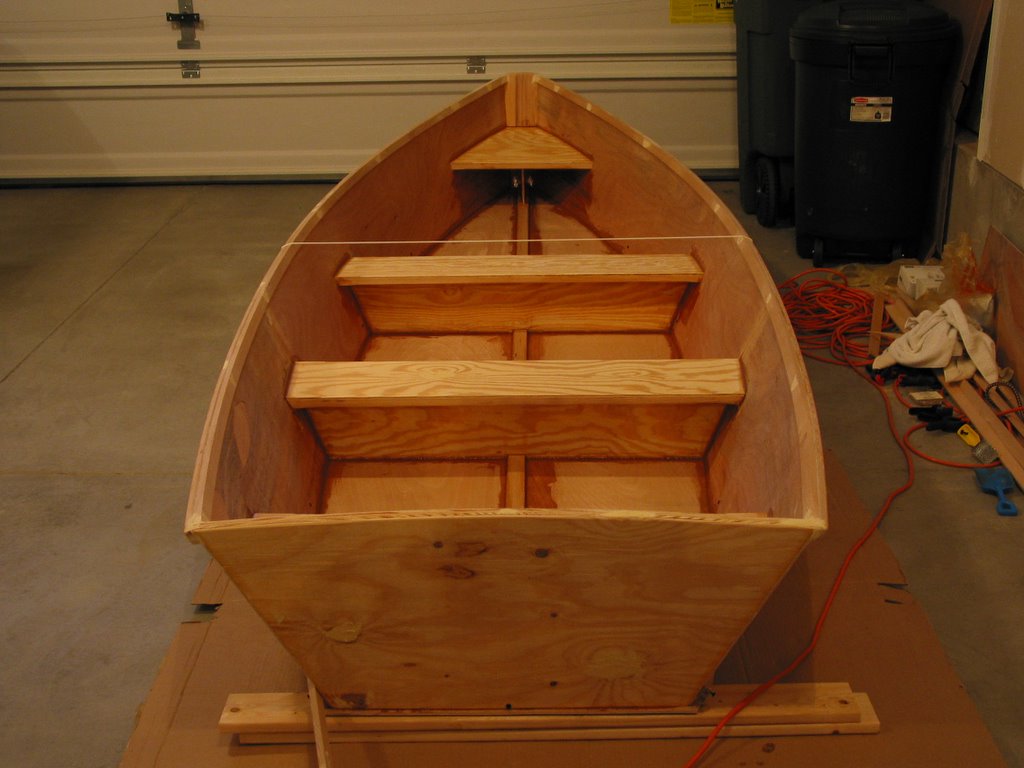
I started applying epoxy and fiberglass to my boat a few days ago. It sounds intimidating, but once you get all the materials in place, and follow all the safety instructions, it is not so bad. I am still getting used to laying the glass fiber, and saturating it with the right amount of epoxy. You apply a coat of epoxy on the wooden core, before it dries (this is the wet layup method), lay the fiberglass cloth on it. Now, you are supposed to apply just enough resin to wet it completely, but not float it off the wooden surface. That is the tricky part. In one occasion, I ended up floating the cloth. In another, I had too little resin and had to soak it again. But, I am getting there.

With epoxy, there is not much reuse of materials. The mixing cup, the stirring stick, spoons, brushes, gloves, all go to the trash after 15- 20 mins. You need to use all the resin before it starts getting hard. Epoxy is what is packaged as super glue in small containers. It comes in two parts: resin and hardener. Alone, both of them are in liquid form. Once you mix them in the right proportion, an exothermic chemical reaction starts, and the molecules bond to form a very strong union. So, at the end of the curing time (20 mins, in my case), all tools used in the application will become useless. This was when I remembered the OHIO acronym. In case of fiberglass, you are forced to complete the work as soon as you start it. This is a great way of making sure that you don't procrastinate. Procrastination, in this case, turns out to be very costly.

Well, the boat core is completely done. I just need to finish off some rough edges, and then I can glass the entire boat.